Healthcare Clock Accuracy: DigitalClock for Medical Ops
Every second counts in healthcare. From the emergency room to the operating suite, precise timing influences patient outcomes. The coordination of medical teams, the administration of treatments, and the integrity of records all depend on a universally synchronized time source. But in a complex hospital environment, how can you ensure every clock is perfectly aligned?
Synchronized atomic time reduces errors in ERs, ORs, and labs. This guide explains why healthcare clock accuracy is non-negotiable for patient safety, operational efficiency, and regulatory compliance. It also shows how DigitalClock.org provides a simple, powerful, and precise solution for any clinical setting, delivering atomic-level precision directly to your browser.
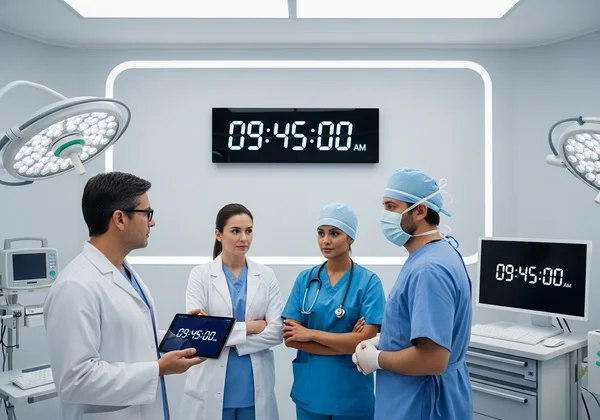
The Imperative of Medical Time Synchronization
In a clinical environment, time is a shared resource that must be consistent for everyone. When the clock in the lab is a minute different from the clock in the operating room, the potential for error increases dramatically. Medical time synchronization is the practice of ensuring all clocks within a healthcare facility display the exact same time, typically aligned with a global standard. This universal consistency is the foundation for safe and effective healthcare delivery.
Without it, confusion can arise during patient handoffs, critical procedures, and medication schedules. A synchronized system eliminates ambiguity, creating a single source of truth that every department can rely on, from administrative staff to surgical teams.
Enhancing Patient Safety and Critical Care
In critical care situations, coordinated action is essential. During a cardiac arrest, for example, team members must perform specific interventions at precise intervals. The time of drug administration, defibrillation, and other life-saving actions must be logged accurately. If clocks are out of sync, the official record of the event can become unreliable, compromising post-event analysis and future patient care.
Synchronized clocks ensure that when a doctor calls out a time, it matches what every other team member sees and records. This alignment is fundamental to patient safety, reducing the risk of delayed responses and procedural errors.
Ensuring Diagnostic Accuracy and Lab Timeliness
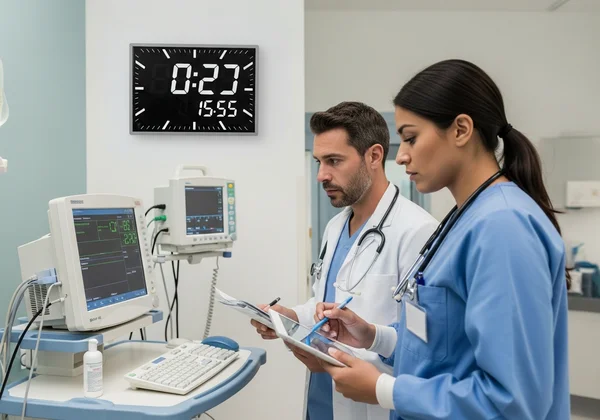
The diagnostic process is deeply time-dependent. Many laboratory tests require specific incubation periods or timed processing steps. A blood sample drawn at 10:00 AM must be logged with that exact time to ensure its viability and the accuracy of the results. Any discrepancy can lead to incorrect interpretations or the need for costly and inconvenient re-testing.
Similarly, in radiology, the timing between contrast injection and imaging is crucial for obtaining clear results. Healthcare clock accuracy ensures that every step in the diagnostic chain is perfectly timed, leading to more reliable diagnoses and better treatment plans.
Medication Administration: Adherence to Strict Schedules
Precise timing is paramount when administering medications. Many drugs, especially antibiotics, chemotherapy agents, and critical care drips, must be given on a strict schedule to maintain their effectiveness and avoid toxicity. A delay of even a few minutes can impact a patient's therapeutic levels.
Nurses and pharmacists rely on accurate clocks to manage these complex schedules. A universally synchronized time source ensures that medication administration records (MARs) are accurate across all shifts and departments, preventing dangerous dosing errors and supporting patient well-being.

Navigating HIPAA Standards with a Compliant Online Clock
In the United States, the Health Insurance Portability and Accountability Act (HIPAA) sets the standard for protecting sensitive patient data. While a clock itself does not store Protected Health Information (PHI), its accuracy is vital for maintaining the integrity of electronic health records (EHRs), which are subject to HIPAA regulations. Using a HIPAA compliant clock is less about the clock itself and more about how it supports a compliant environment.
Accurate timestamps are a core component of data integrity. They provide a verifiable record of when information was created, accessed, or modified. An unreliable time source can undermine the legal and clinical validity of patient records.
Securing Time Data: Beyond Basic Display
Timestamps in patient records are legally binding. DigitalClock.org ensuresthat the time displayed to medical staff aligns perfectly with the Network Time Protocol (NTP) servers used by electronic health record systems. By relying on an atomic-synced source, hospitals prevent the dangerous "drift" that occurs with standard wall clocks.
This synchronization creates a verifiable audit trail. If a legal dispute arises regarding the timeliness of care—such as the administration of a clot-busting drug for a stroke victim—the timestamp in the EHR and the time the medical team acted upon must be identical. A browser-based digital clock that calibrates constantly ensures that the visual time reference and the digital record are one and the same, safeguarding the institution against liability claims based on timing discrepancies.
Reducing Operational Friction and Billing Errors
Beyond life-and-death scenarios, the accuracy of a digital clock (数字时钟) significantly impacts the operational bottom line of healthcare facilities. Hospital efficiency relies on the smooth flow of patients through various departments, from admission to discharge.
Optimizing Operating Room Turnover
Operating rooms (ORs) are among the most expensive resources in a hospital. Maximizing OR utilization requires precise tracking of "wheels in" to "wheels out" times, as well as the turnover time between cases. If the clock in the pre-op holding area lags behind the clock in the OR, scheduling conflicts arise, leading to wasted time and frustrated surgeons.
Using a synchronized digital clock solution on screens in every corridor and suite ensures that the surgical flow moves to a single beat. Accurate tracking of anesthesia time is also critical for billing; insurance reimbursements are often calculated based on time units. A discrepancy of just a few minutes per case, extrapolated over thousands of surgeries a year, can result in significant revenue leakage or audit penalties.
Streamlining Shift Changes and Staff Coordination
Healthcare is a 24/7 operation that relies on seamless shift changes. Nurses and doctors need a reliable reference for clocking in and out, as well as for the "handoff" of patient responsibilities. A unified time source prevents disputes over shift durations and ensures that overtime is calculated fairly.
Moreover, during a shift, the coordination between support staff (porters, cleaners) and clinical staff is driven by time. When a digital clock on a central dashboard is visible to all, coordination improves. For instance, if a bed needs to be cleaned by 14:15 for a new admission, a synchronized display ensures maintenance staff and admitting nurses are working toward the exact same deadline.
DigitalClock.org: The Modern Solution for Medical Precision
Traditional hard-wired clock systems are expensive to install and difficult to maintain. They often require complex master clock hardware and physical cabling throughout the facility. DigitalClock.org offers a modern, software-based alternative that leverages existing IT infrastructure to deliver atomic-level accuracy.
Why Browser-Based Clocks Work for Healthcare
- Zero Infrastructure Cost: There is no need to purchase specialized hardware. DigitalClock.org runs on any device with a browser—desktop computers at nurses' stations, tablets on crash carts, or smart TVs in waiting areas.
- Atomic Precision: The tool syncs with atomic time servers, ensuring that the display is accurate to the millisecond, meeting the rigorous demands of medical standards.
- Visual Clarity: In a chaotic ER or a dimly lit Radiology reading room, visibility is key. The full-screen digital clock mode offers high-contrast numerals (often red or green on black) that are easily readable from a distance, reducing cognitive load for busy staff.
- Night Mode & Customization: For wards where patients are sleeping or for darkrooms used in imaging, the display can be adjusted to reduce glare while maintaining readability, a feature often lacking in standard analog clocks.
Implementation Scenarios
- The Trauma Bay: Set a large monitor to DigitalClock.org in full-screen mode. When a trauma patient arrives, the entire team has a unified reference for the "Golden Hour."
- Telehealth Consultations: Doctors conducting remote visits can use the tool to ensure they log call start and end times accurately for insurance claims, regardless of their computer's internal system lag.
- Waiting Rooms: Displaying an accurate digital clock alongside queue information helps manage patient expectations and anxiety regarding wait times.
Time is the Vital Sign of Operations
In the high-stakes world of healthcare, time is more than just a measurement; it is a vital sign of the hospital's operational health. Just as a patient's heart rate reflects their physical status, the accuracy of a facility's timing reflects its organizational competence.
From the split-second decisions in the ICU to the minute-by-minute tracking of medication in the pharmacy, healthcare clock accuracy is the invisible thread that holds the complex tapestry of medical care together. It protects patients from errors, shields the hospital from liability, and ensures that valuable resources are used efficiently.
By adopting a reliable, accessible, and precise solution like DigitalClock.org, medical facilities can modernize their approach to timekeeping. It is a simple upgrade with profound implications: reducing risk, enhancing care, and ensuring that when every second counts, everyone is counting the same second.
Ready to synchronize your team? Visit DigitalClock.org today to access a precise, full-screen digital clock suited for any medical environment.